Welcome to Yeedu
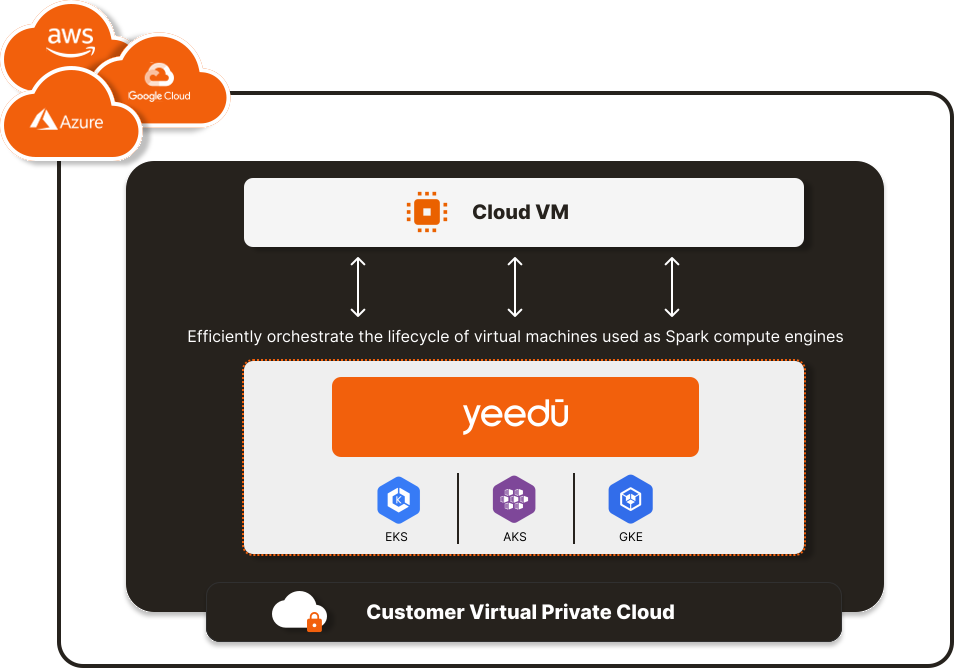
Yeedu is a multi-cloud platform that orchestrates the lifecycle of Apache Spark as a managed compute resource on AWS, Azure, and Google Cloud. A single Yeedu deployment lets you provision, run, and govern Spark workloads across any of these clouds — without rewriting your data pipelines or stitching together vendor-specific services.
Why teams choose Yeedu
Yeedu is built by data engineers who have spent years operating Apache Spark for large enterprises. The platform is designed to remove the biggest pain points of running Spark at scale.
Stability
Most managed Spark services run on Kubernetes — and most managed Kubernetes services (EKS, AKS, GKE) run on nested virtualization. Every instruction is translated by the guest hypervisor before reaching the host, which adds CPU overhead and unpredictable tail latency for analytics workloads.
Yeedu avoids that overhead. It directly orchestrates virtual machines and bare-metal hosts using a scheduler designed from the ground up for cloud Spark workloads.
Cost
Many Spark vendors charge a multiple of the underlying compute cost. Yeedu is built to minimise that markup so the price you pay closely tracks the resources you actually consume.
Multi-cloud and portability
You can move workloads between AWS, Azure, and GCP without rewriting your foundational code. This lets you take advantage of cloud-specific discounts today without being locked in tomorrow.
Resource optimization
- Yeedu ships multiple schedulers, including one optimized for I/O-bound jobs that delivers up to 5× the throughput of generic schedulers like Kubernetes, YARN, or Mesos.
- Running compute close to your data — possibly across more than one cloud — reduces cross-region and cross-cloud egress costs.
Multi-version Spark support
Yeedu offers several Long Term Support (LTS) versions of the Apache Spark runtime, so you can pin production jobs to a known-good version and migrate at your own pace.
Where to next
- New to Yeedu? Start with Get started for the end-to-end workflow.
- Want the high-level picture first? Read Architecture and Concepts.
- Ready to install? Jump to Set up Yeedu and pick your cloud.